
Sora availability check · Migration playbook · Updated July 2026
Sora Alternative - Migration Playbook for AI Video Teams
Verify current Sora availability in OpenAI's official documentation before planning any cutoff or migration timeline. This page is the migration playbook, not an official OpenAI sunset calendar. The recommended target is Seedance 2.0: actively maintained, globally available, public API, native audio, multi-reference generation, credit-pack entry at $15.
By Jay Yang·Editor, AI Video Technology·9 min read·
First check
OpenAI Sora status
Verify web, app, plan, and API access in official OpenAI docs.
Then benchmark
Active replacement quality
Compare clip length, audio, prompt transfer, and API reliability.
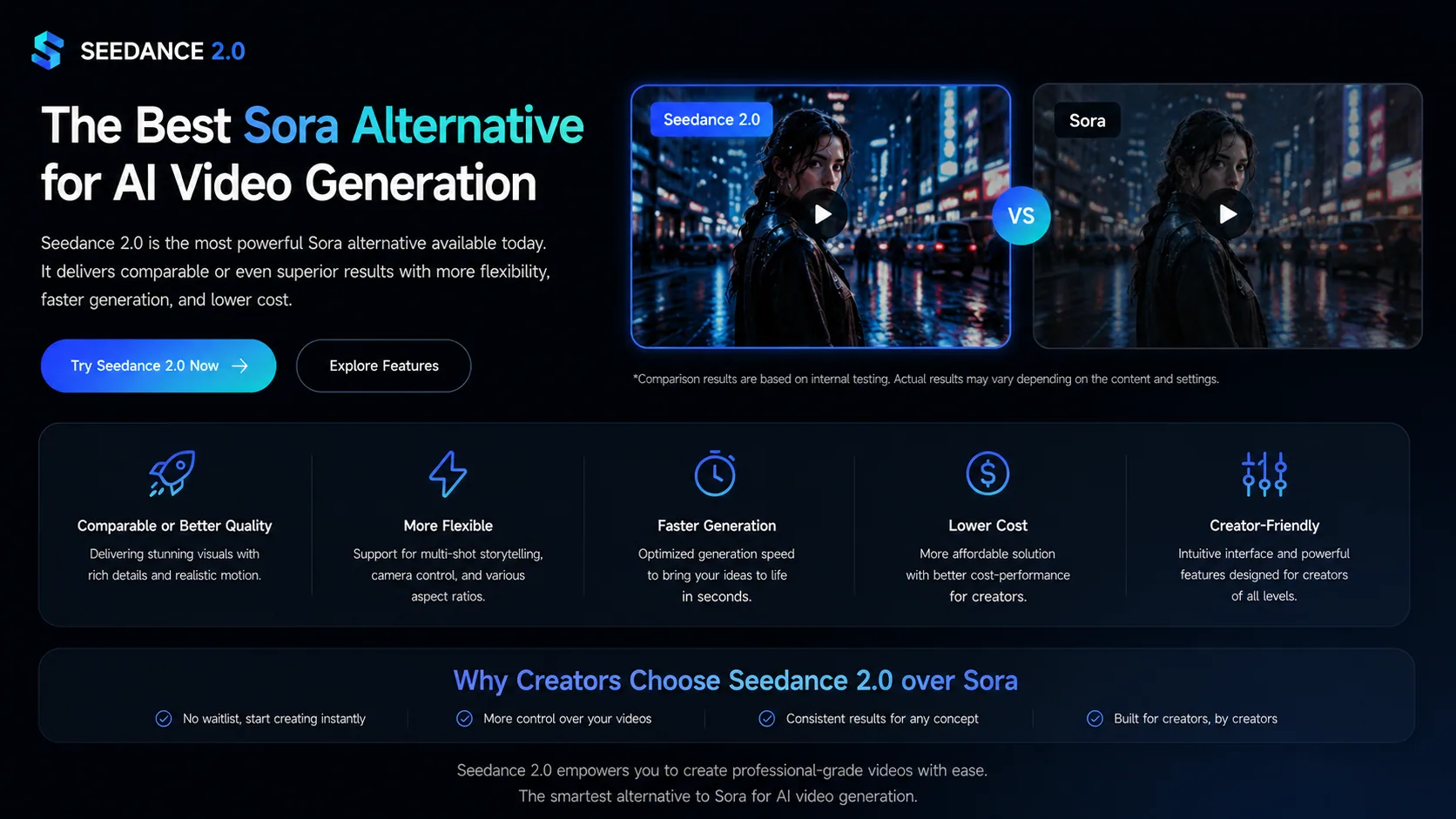
Direct answer - Comparisons and Alternatives
Use this page as a Sora-style migration checklist, not an OpenAI status page. Verify current Sora web, app, plan, and API availability in OpenAI documentation first. Then compare active alternatives on clip length, audio, reference inputs, API reliability, cost, and prompt-transfer effort before moving production workflows.
Operator disclosure
Seedance2Video is operated by Vividra Labs LLC as an independent third-party interface. It is not ByteDance, Doubao, Jimeng, or Volcengine Ark. ByteDance / Volcengine sources remain the authority for official model and API facts.
Verified date
- source list and page claims should be rechecked when vendor documentation changes.
Four-cluster GEO map
Entity Trust
Define what Seedance is, who operates each access surface, which sources are official, and how Seedance2Video discloses its third-party role.
Usage Tutorials
Help users generate better outputs with prompt, text-to-video, image-to-video, reference, and video-to-prompt workflows.
Commercial Conversion
Explain pricing, free access, credit packs, PayPal checkout expectations, commercial use, and refund/support paths.
Comparisons and Alternatives
Compare Seedance against Sora-style workflows and other AI video tools without overstating availability or official affiliation.
Key facts at a glance
Sora status
Verify current availability in official OpenAI product documentation
Recommended migration posture
Validate an active replacement before moving production workflows
Seedance 2.0 entry
Mini Pack $15 / 300 credits
Seedance 2.0 credit validity
12 months (no monthly reset)
Seedance 2.0 commercial rights
Included on every paid plan
Sources: OpenAI Sora announcements, ByteDance Seed launch posts, Volcengine Ark documentation, Seedance2Video pricing. Verified May 2026.
The 30-second verdict
Move now. The deadline is not negotiable.
If you are running production work on Sora-style workflows, verify current Sora availability in official OpenAI documentation before planning any cutoff or migration timeline. The highest-leverage replacement for many teams is Seedance 2.0 because it is actively maintained, globally accessible, exposes API-based access, supports multi-reference generation and native synchronized audio, and has a no-subscription credit-pack entry at $15. Treat this page as a migration playbook, not an official OpenAI sunset calendar.
Choose Seedance 2.0 if
- ✓You want a public API that is not on a sunset schedule
- ✓You need synchronized audio and lip-sync in one generation pass
- ✓You prefer credit packs over a recurring subscription
- ✓Multi-reference generation matters for campaign consistency
Consider Veo 3 or Kling 3.0 instead if
- ○You are deep inside Google Workspace / Vertex AI (Veo 3)
- ○You need maximum motion fidelity for action sequences (Kling 3.0)
- ○Your team has zero appetite for a new vendor and you can wait
For the head-to-head capability table, see Seedance 2.0 vs Sora 2. This page covers what to do once the decision is made.
Context
Why Sora is leaving — and what that means for your pipeline
What to verify first
Before quoting Sora availability, API status, or a product replacement plan, check OpenAI's current Sora product and help-center documentation. Third-party pages should not be treated as authoritative for OpenAI availability.
What this means for paying users
If Sora access changes for your plan, product surface, or API key, your first task is to preserve prompts and outputs, then benchmark an active replacement against your clip length, aspect ratio, audio, and reference-input needs.
What you should not assume
Do not assume a lifetime grandfather path, a self-hosted Sora release, or a fixed migration window unless OpenAI currently documents it. Build migration plans around verified access, not copied dates.
5-step playbook · ~90 minutes for a solo creator
Migrate from Sora 2 to Seedance 2.0
A structured cutover. Each step is independent — you can stop after step 3 and still have a working replacement; steps 4 and 5 are for teams preserving an existing prompt library or API automation.
- 1
Inventory your active Sora workflows
List every place a Sora generation appears in your pipeline: ChatGPT prompts, custom GPT actions, API scripts, ad-creative batch jobs, social calendars. For each, note the average clip length, aspect ratio, and whether audio is required. This is the spec you will hand to whatever replaces Sora — without it, you are migrating blind.
- 2
Map output style to a Seedance 2.0 mode
Sora 2 is a single general-purpose model; Seedance 2.0 splits its workload across Standard (slower, higher fidelity, supports 4 / 8 / 12 / 15 second clips) and Fast (lower latency, supports 4 / 8 / 12 seconds). Most narrative or product work translates to Standard at 12 seconds; most reels-style B-roll fits Fast at 8 seconds. The native audio output is on by default — you do not need a separate TTS layer.
- 3
Re-cost your monthly budget against credit packs
Stop thinking in subscription seats and start thinking in credits per generation. The Mini Pack at $15 lands 300 credits with 12-month validity. The Creator pack at $69 lands roughly five times that with the featured per-credit price. If you were spending $200 per month on ChatGPT Pro for Sora alone, the credit-pack equivalent is meaningfully cheaper — and unspent credits do not vanish at the end of the billing month.
- 4
Translate three representative prompts and benchmark
Pick three prompts that cover your range — one dialogue-driven, one motion-heavy, one product close-up. Run each on Seedance 2.0 Standard at 1080p. Note the differences: Seedance 2.0 tends to follow camera direction more literally; Sora 2 tends to interpolate motion more dramatically. Adjust the camera and pacing tokens in your prompt library accordingly. The full prompt-translation pattern guide is on the Seedance Prompts page.
- 5
Wire the API or batch tool against the new endpoint
For developer use, re-point the API client at Seedance 2.0 via the Volcengine Ark endpoint or via Seedance2Video's hosted credit-based access. For non-developer teams, run your batches through the web generator — the queue position is shown live, and outputs land in your account history with 12-month retention. Verify two consecutive runs before turning off your Sora workflow.
Output style mapping
What changes in your output — and what does not
Six common scenarios across the Sora workflow, with the literal change you can expect once the same intent runs through Seedance 2.0.
| Scenario | On Sora 2 | On Seedance 2.0 |
|---|---|---|
| Talking-head product explainer | Sora 2 generates ambient audio and approximate mouth motion; you usually overlay an external voiceover. | Seedance 2.0 generates synchronized multilingual lip-sync as part of the same generation pass. The voiceover layer is no longer a separate step. |
| Multi-shot narrative (15–60 seconds total) | Sora 2 returns single clips of up to 25 seconds on Pro; multi-shot stitching is manual. | Seedance 2.0 supports multi-shot sequences with consistent characters across cuts within one generation request — your storyboard becomes the prompt rather than a series of separate jobs. |
| Reels / Shorts B-roll | Plus tier limits to 720p with roughly 50 generations per month. | 1080p output is the default on every paid pack. A Mini Pack at $15 covers a normal month of short-form B-roll for an individual creator. |
| Brand-consistent campaign clips | Sora 2 has no multi-reference mode; brand-asset consistency relies on prompt repetition and post-pick. | Multi-reference generation lets you pin up to several reference images per generation, locking in subject and style across the campaign. |
| Vertical 9:16 social ads | Vertical supported but resolution capped at the Sora tier you pay for. | 9:16 supported natively at 1080p; the commercial-use rights are bundled with the credit pack. |
| API-driven batch automation | Verify current Sora API availability in OpenAI documentation before relying on it for batch automation. | Seedance 2.0 is exposed via Volcengine Ark (pay-per-token) and via Seedance2Video's hosted access (credit-pack billing). Both remain active. |
Wallet redirect
Re-cost your monthly Sora budget against Seedance credit packs
The biggest mental shift is moving from "rent a seat" to "buy credits that do not expire for a year." Four common profiles below.
| Profile | Current Sora cost | Current cap | Recommended pack | What you get |
|---|---|---|---|---|
| Solo creator — occasional clips | $20 / month (ChatGPT Plus) | ~50 clips at 720p / month | Mini Pack — $15 one-time | 300 credits · 12-month validity · 1080p |
| Active short-form creator | $20 / month (Plus, often topped up) | ~50 clips at 720p / month | Starter Pack — $39 one-time | Higher per-credit value than Mini; 1080p across the board |
| Agency / freelance — daily output | $200 / month (ChatGPT Pro) | ~500 clips at 1080p / month | Creator Pack — $69 one-time (featured tier) | Best per-credit price; 12-month validity; multi-reference enabled |
| Heavy commercial / studio | $200 / month (Pro) + API spend | 500 clips + ad-hoc API | Studio Pack — $129 one-time + monthly $79 plan | Largest single pack; pair with subscription for predictable monthly throughput |
Volumes are illustrative; actual per-clip credit cost varies by mode, length, and resolution. See the pricing page for the canonical credit table.
Prompt translation
Three before / after examples
Most prompts transfer with minor adjustments. Seedance 2.0 rewards explicit camera, pacing, and audio tokens. Patterns shown below; the full translation guide is on the Seedance Prompts page.
Cinematic product reveal
Sora 2 prompt
A slow cinematic shot of a black ceramic coffee mug on a marble counter, warm window light, steam rising, shallow depth of field, 8 seconds.
Seedance 2.0 prompt
Camera: slow dolly-in on a black ceramic coffee mug, marble counter, warm 5500K window light from camera-right, soft steam rising in a continuous spiral, shallow depth of field. Pacing: 8 seconds, no cut. Aspect: 16:9, 1080p, Standard.
Why it changes: Seedance 2.0 follows explicit camera and pacing tokens more literally — naming "dolly-in" and "no cut" prevents the model from inventing a transition.
Vertical reel with on-screen dialogue
Sora 2 prompt
A barista in a green apron behind a counter, looking at the camera, saying "this is our new oat blend," steam machine in background, vertical, 10 seconds.
Seedance 2.0 prompt
Vertical 9:16, 8 seconds. Barista in green apron, mid-shot, eye-contact with camera, speaking the line "This is our new oat blend." Background: steam wand operating, slight shallow focus. Audio: enable lip-sync (English, neutral US accent). Mode: Standard.
Why it changes: Sora 2 typically renders the dialogue line as ambient sound; Seedance 2.0 needs the lip-sync flag turned on explicitly, then matches mouth motion to the line.
Multi-reference brand asset
Sora 2 prompt
A model walking down a sunlit street wearing a beige trench coat, brand X logo visible, cinematic, 6 seconds.
Seedance 2.0 prompt
Multi-reference generation. Reference 1: model headshot (consistency anchor). Reference 2: trench coat product image. Reference 3: brand X logo plate. Scene: sunlit street, hand-held tracking shot, model walks toward camera, 6 seconds, 1080p, 9:16.
Why it changes: Sora 2 has no multi-reference mode — you would need three separate generations and a post-pick. Seedance 2.0 binds all three references in a single pass.
Glossary
Migration vocabulary
- Sora 2
- OpenAI's text-to-video and image-to-video model. Verify current web, app, plan, and API availability against official OpenAI documentation before citing status or timeline.
- Seedance 2.0
- The current main video generation model line from ByteDance Seed, released February 12, 2026. Supports text-to-video, image-to-video, multi-reference generation, native synchronized audio with multilingual lip-sync, and multi-shot sequences.
- Migration playbook
- A structured five-step process for moving production AI-video workflows off a sunsetting platform — inventory, mode mapping, re-cost, prompt translation, and endpoint cutover.
- Credit pack
- A one-time purchase of generation credits with a 12-month validity window. Unlike a subscription, credits do not reset at the end of the billing month and require no recurring charge.
- Multi-reference generation
- A generation mode that accepts multiple reference images per request, pinning subject, style, and brand assets across the output. Available on Seedance 2.0; not available on Sora 2.
- Lip-sync mode
- A generation flag that aligns the model's mouth motion to a spoken line. Native to Seedance 2.0 with multilingual support; Sora 2 generates ambient audio without precise lip alignment.
- Availability status
- The current documented access state for a hosted product surface or API endpoint. Verify it from the product owner before changing production workflows.
People also ask
Common questions from teams migrating off Sora
Q.Why might teams look for a Sora alternative?
Teams usually evaluate Sora alternatives when plan access, API availability, pricing, or workflow fit changes. Verify current Sora availability with OpenAI first, then benchmark replacements on clip length, prompt adherence, audio, and reference-input needs.
Q.What is the best replacement for Sora 2 in 2026?
For most teams the highest-leverage replacement is Seedance 2.0 — it has a public API, native synchronized audio with multilingual lip-sync, multi-reference generation that Sora 2 does not offer, 1080p output across all paid tiers, and a credit-pack entry at $15 with no subscription. Veo 3 and Kling 3.0 are also viable; Seedance 2.0 wins on access continuity and per-clip cost.
Q.Can I still use my Sora subscription?
Check your current OpenAI plan and Sora product documentation. Availability can vary by surface, plan, region, and API status; this page does not publish a fixed cutoff calendar.
Q.How much will I save by moving from ChatGPT Pro to Seedance 2.0?
A $200 per month ChatGPT Pro plan dedicated to Sora generation buys roughly 500 clips per month at 1080p, with the budget reset each billing cycle. The Seedance 2.0 Creator credit pack at $69 one-time covers a comparable monthly volume for many teams, with 12-month credit validity and no recurring charge. Heavy studios usually pair the $79 monthly plan with a Studio credit pack for predictable throughput.
Q.Do I have to rewrite all my Sora prompts?
No — most prompts transfer with minor adjustments. Seedance 2.0 responds more literally to explicit camera, pacing, and audio tokens (for example "dolly-in", "no cut", "enable lip-sync"). The Seedance Prompts page documents the full translation pattern. Plan on a one-time prompt audit, not a rewrite from scratch.
Q.Is there a self-hosted Sora alternative I can run on my own GPU?
Not at production quality. Open-source video models exist (such as Mochi 1 and CogVideoX) but the output gap against Sora 2 or Seedance 2.0 is substantial for most commercial work. For teams that need on-premise inference, the Volcengine Ark API offers the most controlled hosted alternative; full self-hosting of a Sora-comparable model is not currently available.
Sourced claims
Every load-bearing claim, with a citation
- 1
Sora availability should be verified against current OpenAI documentation before migration planning.
OpenAI is the canonical source for Sora product, plan, and API availability. Treat any third-party Sora migration guide as advisory unless it links to current OpenAI documentation.
Source: OpenAI — Sora product page
- 2
Seedance 2.0 is an actively maintained, publicly accessible video generation model.
ByteDance Seed published the Seedance 2.0 launch announcement on February 12, 2026. The model is documented on Volcengine Ark with pricing and licensing terms, and has its own Wikipedia entry. No discontinuation has been announced.
- 3
Seedance 2.0 supports native synchronized audio with multilingual lip-sync.
Seedance 2.0 generates background music, sound effects, and dialogue audio as part of the unified model output, with purpose-built multilingual lip-sync for dialogue-driven clips. This is a documented capability difference relative to Sora 2.
- 4
Seedance 2.0 access on Seedance2Video starts at $15 for a one-time credit pack.
The Mini Pack lands 300 generation credits with 12-month validity at $15. The Creator credit pack at $69 is the featured tier for active users. There is no free trial and no signup credits — the credit pack is the entry path.
Source: Seedance2Video — pricing page
FAQ
More on the sunset, pricing, and migration timing
When exactly does Sora stop working?
This page no longer publishes hard-coded Sora availability dates. Check official OpenAI Sora product and help-center documentation for the current status of web, app, and API access.
Do I need to migrate immediately?
Migrate only after you verify your actual Sora access path and test replacement quality. Teams with production dependencies should preserve prompts and outputs, run benchmark generations on an active alternative, and switch only after two successful validation runs.
Is Seedance 2.0 actually available worldwide, or is it China-only?
The Seedance 2.0 model is globally accessible through the Volcengine Ark API and through international third-party integrators like Seedance2Video. The consumer surfaces operated directly by ByteDance (Doubao, Jimeng) are Chinese-language and oriented to the Chinese market, but the underlying model accepts traffic worldwide.
Will my Sora-generated content remain available?
Do not rely on indefinite hosted retention for any generated-media platform. Download outputs, prompts, and source assets you need to keep, then verify OpenAI's current retention terms for your plan.
How long does a typical migration take?
For a solo creator, an afternoon — inventory three to five recurring prompts, re-cost against a credit pack, and re-run two benchmark clips. For an agency or in-house team running batched ad creative, plan one to two weeks: that covers prompt-library audit, two-platform parallel run, and API client cutover.
Can I use Seedance 2.0 for commercial work right after migration?
Yes. Commercial usage rights are included on every paid Seedance 2.0 plan and credit pack on Seedance2Video. There is no separate commercial tier and no per-output royalty. The commercial-use page on this site documents the scope.
What if I prefer Veo 3 or Kling 3.0 as my Sora replacement?
Both are viable. Veo 3 is strongest if you are already deep in Google Workspace and want Vertex AI integration. Kling 3.0 is competitive on motion and a strong Chinese-language option. Seedance 2.0 wins on credit-pack pricing, multi-reference generation, and native multilingual lip-sync — the differentiated comparison pages on this site cover each head-to-head.
Where do I read the deeper Sora-versus-Seedance side-by-side?
For a feature-by-feature comparison of capability, length, audio, and pricing, see the Seedance 2.0 vs Sora 2 page. This page is the migration-decision counterpart — what to do once you have decided to move.
Start the migration today
$15 buys you 300 credits. Credits are valid 12 months.
No free trial, no signup credits — just a one-time pack that lets you re-run your three benchmark Sora prompts and decide for yourself before changing production workflows.